

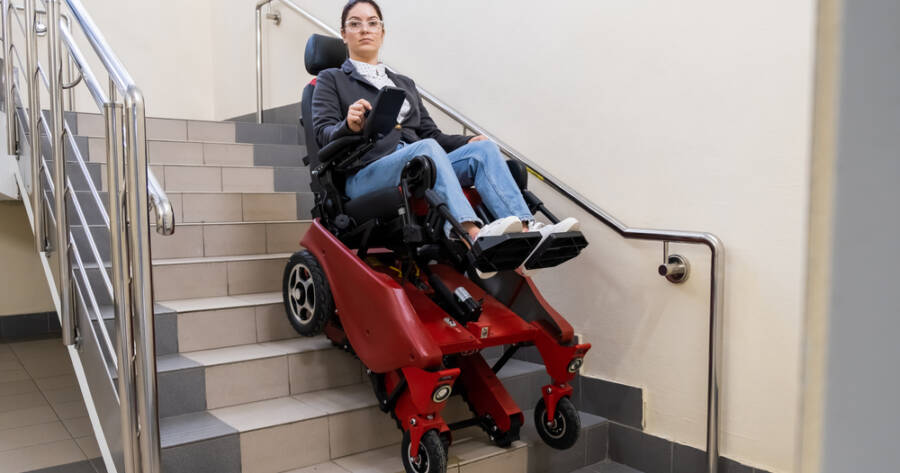
Portable stairlifts offer a practical, installation-free solution for individuals who need help navigating stairs — whether recovering from surgery, aging in place, or supporting a loved one in a home that cannot accommodate permanent modifications.
What Makes a Portable Stairlift Different
Traditional stairlifts are permanently mounted systems that require professional installation and structural modifications to a home. A rail is fixed to the wall or stair treads, and a motorized chair connects to that rail, allowing a rider to travel up or down in a seated position (source). While effective, these systems are a long-term commitment that often cannot be undone easily, making them impractical for renters, temporary caregiving situations, or households with multiple stairways.
Portable stairlifts take an entirely different approach. Rather than being anchored to walls or railings, these devices are freestanding, battery-powered, and can be ready to operate within minutes of being unboxed (source). Their foldable, compact designs make them easy to transport between locations and store when not in use — something a traditional mounted system simply cannot offer (source).
The Mechanical Systems Behind Portable Stairlifts
Understanding how a portable stairlift actually climbs a staircase requires a look at its core mechanical components. Most portable models rely on a tracked system, where treads or tracks are fitted around the wheels to generate the grip and traction needed to hold firmly against each step (source). This design distributes the device’s weight across multiple steps at once, which keeps it stable throughout the ascent or descent.
The motor is what drives those tracks. Powered systems built into portable stairlifts allow the device to move smoothly in both directions, propelling its occupant either upward or downward without requiring manual pushing or pulling from a caregiver (source). Advanced balancing technology works alongside the motor to counteract tipping forces that naturally arise when navigating an incline, keeping the platform level and the rider secure throughout the entire journey (source).
A caregiver typically manages the device through straightforward controls — often a joystick or push-button interface — rather than requiring any technical expertise (source). This simplicity is intentional. The device is designed so that family members, home health aides, or other non-specialists can operate it safely after minimal orientation.
Built-In Safety Features
Portable stairlifts incorporate multiple layers of protection to minimize risk during operation. Anti-slip treads on the platform prevent the rider from shifting during movement, while seat belts keep the occupant secured in place throughout the trip. Emergency stop functions allow the operator to halt the device immediately if something unexpected occurs (source).
The importance of stair safety for older adults is well established. According to the CDC, one in four Americans over 65 experiences a fall each year, with stairs representing one of the most common hazard points — a fact that underscores the practical value of a device that can reduce stair-related risk without requiring permanent home alterations (source).
Battery Power and Carrying Capacity
Portable stairlifts run on rechargeable batteries, eliminating the need for wall outlets or electrical wiring along a staircase. Some models demonstrate impressive endurance — for example, the Genesis Mobile Stairlift is capable of carrying riders weighing up to 400 pounds across as many as 120 flights of stairs on a single charge (source). For comparison, standard traditional stairlift chairs are typically rated for around 300 pounds, with heavy-duty versions reaching 600 pounds or more (source).
Battery-powered operation also means these devices can function in homes where electrical infrastructure near the staircase is limited or nonexistent, which expands their usefulness considerably for older housing stock, vacation properties, or short-term rental situations.
Who Benefits Most From Portable Stairlifts
Portable stairlifts address a wide range of real-world circumstances that traditional systems cannot easily serve. Post-surgical recovery is one major use case — someone returning home after a hip or knee procedure may need stair assistance for only a few weeks or months, making permanent installation both unnecessary and financially inefficient. Caregivers who move between households with different stair configurations also benefit from having a single device that can travel with them rather than purchasing multiple permanent systems (source).
Renters face particular challenges when it comes to home accessibility modifications, since landlord approval and lease restrictions frequently prevent structural changes. A portable stairlift bypasses those barriers entirely by requiring no installation whatsoever. The same logic applies to multi-story homes with more than one staircase — a single portable unit can be moved from location to location as needed, unlike a mounted rail system that stays fixed in one spot.
Older adults who want to extend their independence at home without committing to costly renovation projects represent another significant audience. The zero-installation nature of these devices means they can be deployed immediately in response to a changing health situation, without waiting for professional contractors or navigating the permitting process that sometimes accompanies structural home modifications.
Why You Should Learn More About Portable Stairlifts Today
Portable stairlifts represent a meaningful shift in how individuals and caregivers approach stair safety and home mobility. By combining tracked traction systems, battery-powered motors, and advanced stabilizing technology, these devices deliver reliable stair assistance without the commitment of permanent installation. Their flexible design serves a broad range of needs — from short-term recovery to long-term caregiving — and their built-in safety features provide meaningful protection for riders at every stage. For anyone evaluating mobility solutions for a loved one or planning ahead for changing physical needs, understanding how portable stairlifts function is a valuable step toward making an informed decision about home accessibility.